Over the years, I’ve spent many a Sunday morning at Camberwell Market. There, I’ve walked the aisles, looking for whatever sparks my interest and making the occasional purchase, and talking to sellers. In October of 2026, I was there with my friend, Paul. We hadn’t been there for a while and we were enjoying the place. I struck up a conversation with a guy I had not met before. (For those who know the market), he’s set up in the aisle closest to Bourke Road in the lower half of the market, and his name is Harry.
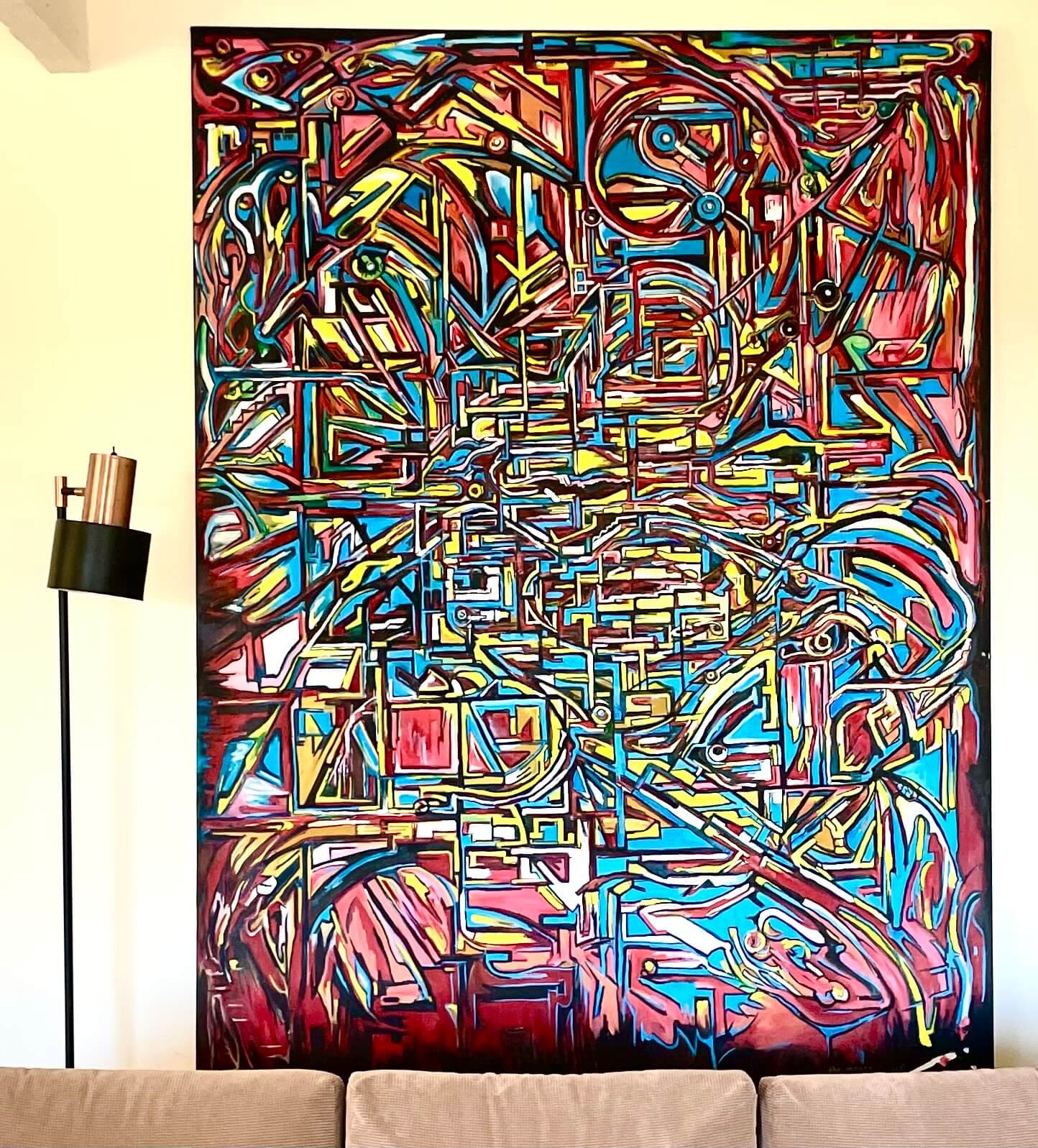
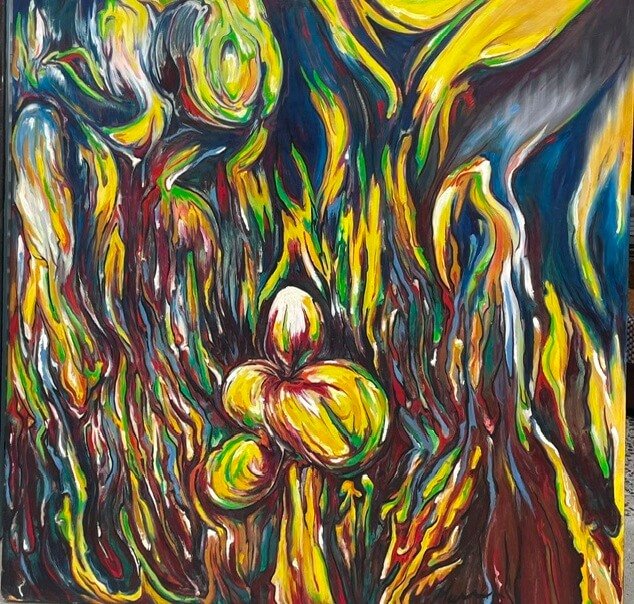
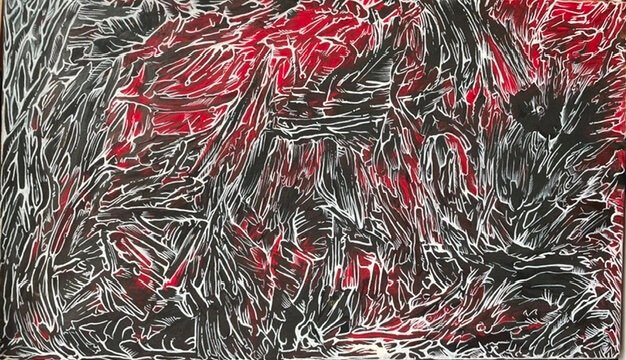
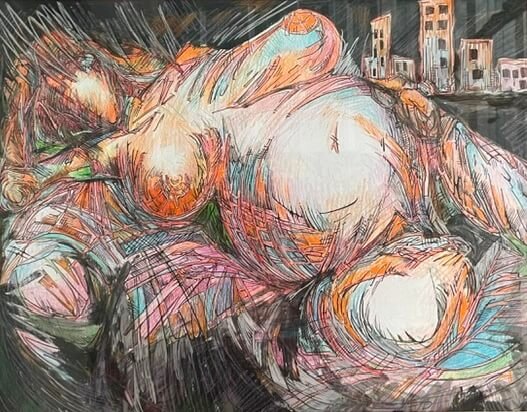
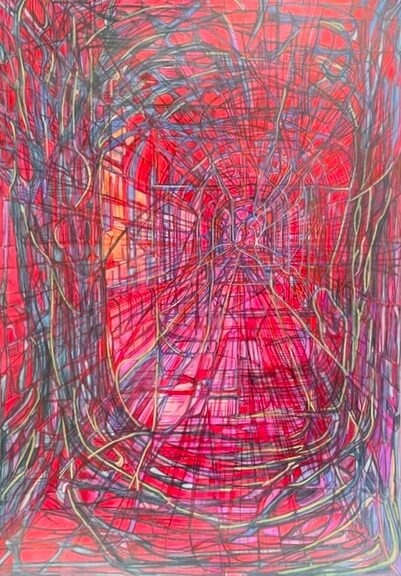
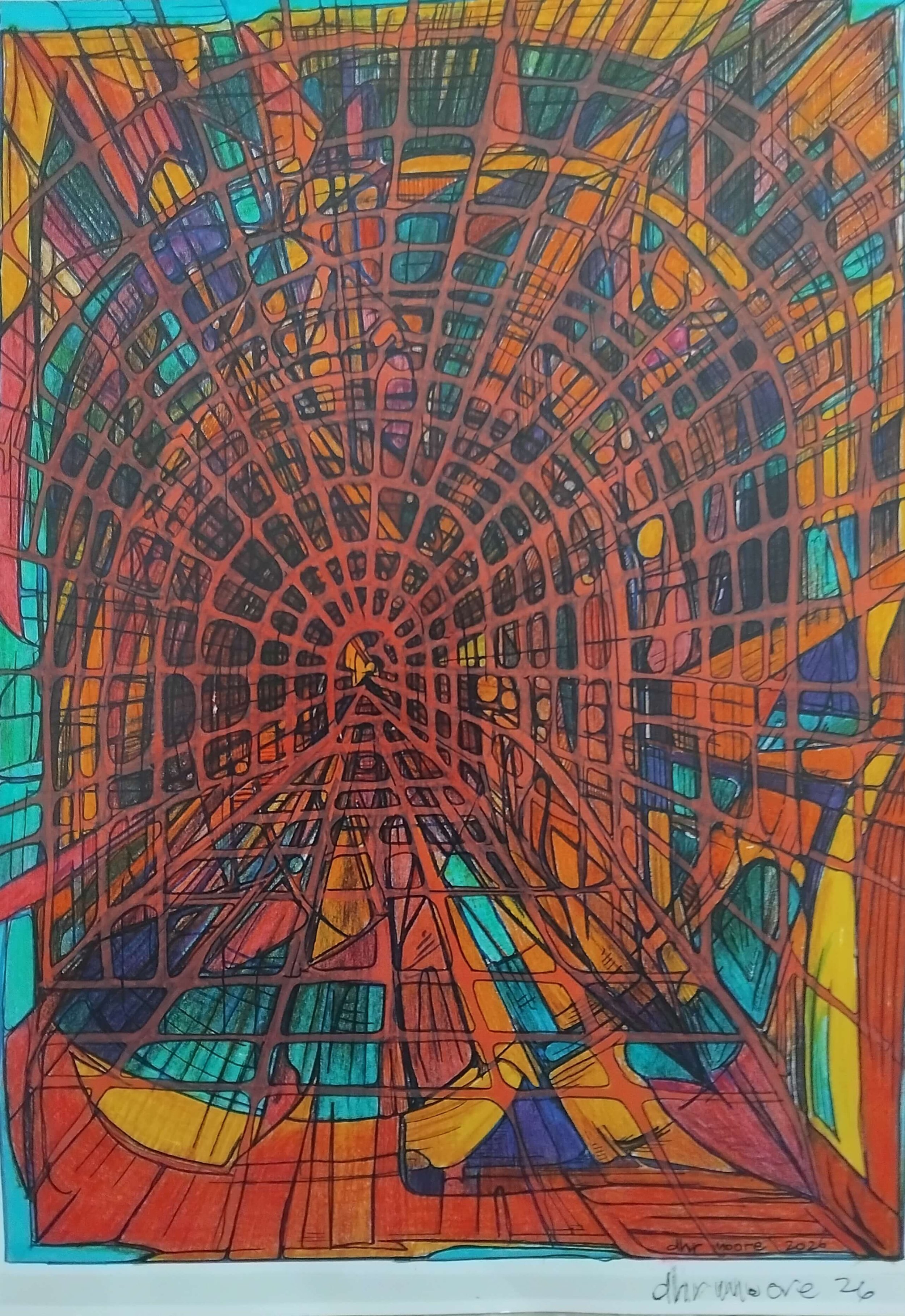
Harry has a van and some things he’s selling, and he has some art. It’s his art. Before long, we strike up a conversation and we’re talking about it. Creatively speaking, I really like what he does. There’s a lot of what looks like abstract art, though as I learn, less abstract than I thought. His work incorporates a lot of converging and diverging lines, a highly defined focal point and a lot of colour. The pictures are busy, complex and energetic. In a way Harry’s art reminds me of Merric Boyd’s; not in subject matter, but in his rigorous use of line.
Art is, for Harry, and for so many creative people like him, his life. And as is often the case, no matter how good they are, it’s a challenge to make a dollar, largely because it’s so hard to get their work exposed to the outside world. Where do you go? Who will show it? How do you afford to get it shown? I’ve often thought that being an artist is one of the toughest occupations in the world. You’re relying on sales of your work and the ebb and flow of your creativity, and on people’s often fickle taste. It’s so much easier for people like myself, who love art, but can’t draw a straight line, let alone create something special. We have the easy part. We just look and enjoy. (I think the romanticised stereotype of the struggling artist is a long way from the truth.)
This blog is about Harry Moore’s art. Personally, I find it complex, original and deep, and aesthetically really pleasing. And like all meaningful art, it’s an insight into the thoughts and feelings of its creator, Harry Moore.
Enjoy.
What I’m About, by Harry Moore
“From early conceptions as line drawings inspired by everyday experiences and surroundings, my feverish imagination transforms my drawings into fascinating and original artworks.
Preferring the medium of pencil on paper, a multitude of ideas flow freely from my mind and are captured in original conception. Drawings are copied and inked, and then copied and coloured, allowing the original concept to evolve in form and style with every new copy. Paintings are developed from an original sketch and translated into an artwork. Based on the original concept, an artwork will often evolve into its own form when the paint hits the canvas. With the belief that there is no ‘wrong’ in art, the works are vivid and unique.
I draw inspiration from diverse artists including James Gleeson, HR Giger, Dr Seuss, JMW Turner, Mort Drucker and Ralph Steadman. A love of fantasy illustration as a child has also featured as inspiration for much of my art.
With a feverish mind for the unimaginable, ideas are expressed as drawing and words systematically form without restraint. These are penned to capture the imagination, and to share the joy of art.”
A Harry Moore Bio
“I grew up in Melbourne’s outer eastern suburbs, and specifically the Croydon and Montrose areas. I was raised in a non-creative family, although I remember enjoying watching my mum draw. My interest in art began around 1982 when I commenced year 7, when I began to find comfort and satisfaction in drawing. I didn’t really take art seriously until my early 20’s when I realised I could express my feelings through illustrations. Always using pencil (usually 2b), I developed a style I like to call ‘morphic’, or ‘having specific form’.
As a kid I was affected by Mort Drucker’s caricatures in MAD Magazine. Later, influences became HR Giger, and Ralph Steadman’s ‘ink blot’ illustrations. I also count JMW Turner as an inspiration.
In my art, I am searching for detail, form and construct. I find drawing both highly therapeutic and rewarding. I use virtually any medium I can get my hands on. Usually, I utilize ink and acrylic paint to develop and complete my works. Completing them is a challenge as I believe no art is finished; only abandoned.
My art often starts from an original scribble. Sometimes finding discarded work in a council clean-up can give me a starting point and inspiration. Drawing parallel (lines) is a something I will continue to produce with the results changing as I find a path to total satisfaction.
I enjoy nothing more than putting pen to paper.”